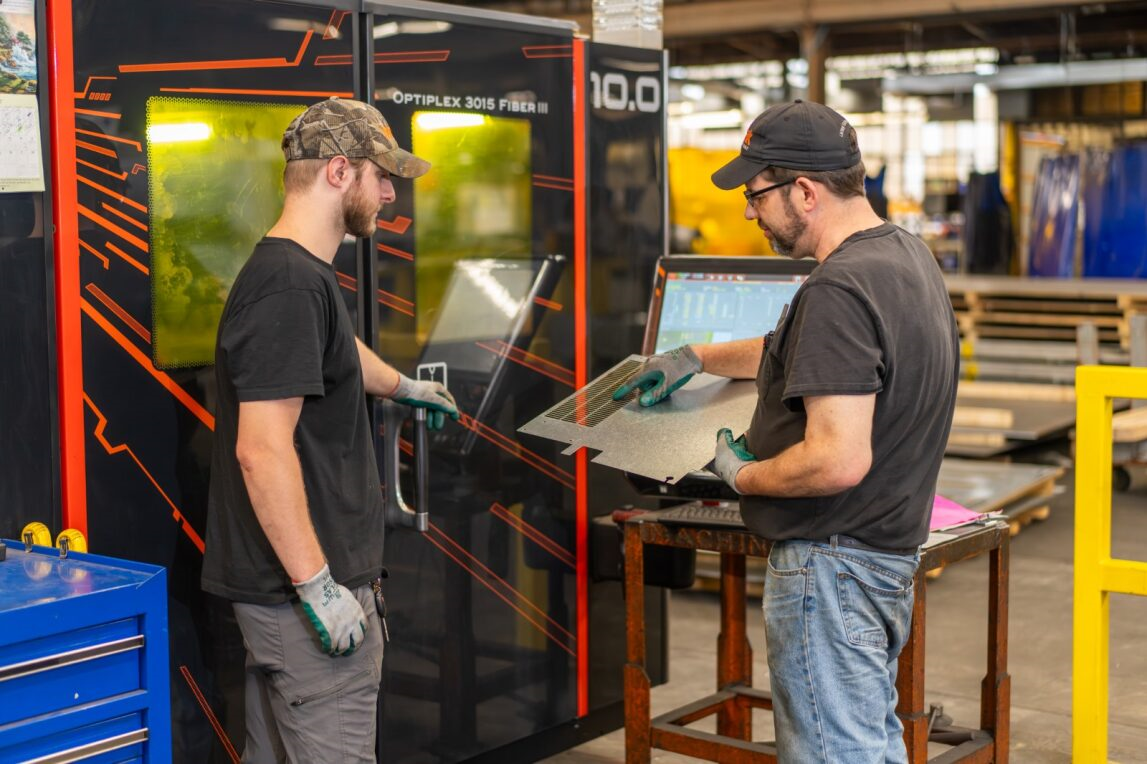
Laser cutting services (our service) have become one of the most relied-on services in modern metal processing, offering a mix of accuracy, repeatability, and throughput that traditional methods often struggle to match. Whether you’re producing one-off prototypes or running high-volume production, laser cutting services can help manufacturers, fabricators, and product teams move from design to finished parts with fewer constraints and less rework.
What laser cutting is—and why it matters
Laser cutting utilises a focused beam of light to melt, burn, or vaporise material along a precisely programmed path. Assisted by gases such as nitrogen or oxygen, the process produces clean edges and tight tolerances while minimising mechanical stress on the part. Because the cutting tool is light (not a physical blade), there’s no tool wear in the usual sense, and complex geometries can be produced without custom dies or punches.
For metal processing, this translates into a highly controllable operation: consistent results, reduced setup time, and the ability to cut intricate patterns that would be slow or costly with saws, milling, or mechanical shearing.
Metals are commonly cut with lasers
Most service providers support a wide range of metals and thicknesses, depending on their equipment (fibre lasers are especially popular for metal). Common materials include:
- Mild steel (carbon steel): widely used for structural components and brackets
- Stainless steel: popular in food-grade, medical, architectural, and industrial applications
- Aluminium: valued for lightweight parts, enclosures, and transport components
- Copper and brass: used in electrical and decorative applications (often requiring specific laser capability)
A good laser cutting shop will advise on thickness limits, edge quality expectations, and the most suitable gas and settings for your chosen metal.
Key benefits of laser cutting services
1. High precision and repeatability
Laser cutting excels where accuracy matters—slot widths, hole placements, and complex contours can be produced reliably across batches. This is especially important for parts that must fit together without adjustment or for assemblies that depend on consistent alignment.
2. Fast turnaround and flexible production
Because laser cutting is driven by digital files (typically DXF or similar), changeovers are fast. That makes it ideal for rapid prototyping, iterative design, and short production runs. When demand increases, the same process scales smoothly to larger quantities.
3. Clean edges and minimal distortion
Compared with some thermal or mechanical methods, laser cutting can deliver a narrower kerf and a cleaner edge finish, reducing the amount of secondary work. Heat-affected zones can still exist, but skilled operators and appropriate parameters help keep distortion low—essential for thin sheets or parts with tight tolerances.
4. Material efficiency and nesting
Shops often use nesting software to arrange parts tightly on a sheet, reducing scrap and improving cost efficiency. This can be a big advantage for expensive metals, large runs, or projects with multiple part shapes.
Typical industries and applications
Laser cutting services support a broad set of industries, including:
- Automotive and motorsport: brackets, mounts, heat shields, panels
- Aerospace and aviation supply chains: lightweight components and precision parts
- Construction and architectural metalwork: decorative panels, railings, cladding details
- Electronics and enclosures: chassis, faceplates, ventilation patterns
- Industrial equipment: guards, frames, machine components, custom fixtures
In many cases, laser cutting is paired with bending, welding, tapping, or finishing to deliver ready-to-assemble kits or complete fabricated assemblies.
What to look for in a laser cutting provider
Choosing the right service is about more than price. Consider:
- Capability match: material types, thickness range, bed size, fibre vs. CO₂ systems
- Quality control: tolerance targets, inspection practices, and part consistency
- File and design support: ability to review drawings, flag manufacturability issues, and recommend adjustments
- Secondary services: deburring, forming, powder coating, anodising, welding, and assembly
- Lead times and communication: clear timelines, responsive quoting, and transparent updates
A strong provider acts as a partner—helping you avoid costly redesigns, suggesting ways to reduce scrap, and ensuring parts arrive ready for the next production step.
Final thoughts
Laser cutting services are a cornerstone of efficient metal processing, enabling precision parts, faster development cycles, and scalable manufacturing without heavy tooling investment. If you’re planning a new product, replacing slow manual processes, or simply need consistent metal parts on a dependable schedule, laser cutting is one of the most practical and cost-effective options available today.